
What Is the Best Treatment for Stretch Marks?
What are the best stretch Mark Treatments, and which one fits me?
Reviewed by Taylor Anderson, RN
Aesthetic Registered Nurse
Taylor Anderson is an aesthetic registered nurse and a reviewer for Hot or Nothing.
Updated October 5, 2026
Quick answer
The best treatment for stretch marks depends on how old the marks are. New red, pink or purple stretch marks respond best to prescription tretinoin cream used at home, with a visible change at about two months. Older white or silvery stretch marks need in-office procedures such as radiofrequency or fractional CO2 laser, and tretinoin paired with bipolar radiofrequency ranked as the most likely best combination in the research.
In this guide
Key takeaways
- Check the color of your stretch marks first: new red, pink or purple marks respond to more treatments than old white or silvery ones, and treatment makes marks less visible rather than gone.
- Skip almond oil, cocoa butter, olive oil and vitamin E because they do not fade stretch marks, and use a self-tanner if you want to hide new or old marks while you treat them.
- Prescription tretinoin cream used every night can shrink new stretch marks and make them less noticeable, with a change showing up at about two months.
- Tretinoin is the place to start for new marks and the cream to keep using if you add an in-office procedure, because tretinoin with bipolar radiofrequency looks like the strongest combination.
- Old white marks need a series of in-office sessions such as radiofrequency or fractional CO2 laser, which MedSpot's cost guide puts at $800 to $2,500 per session for RF microneedling and $1,500 to $4,000 per session for CO2 laser, and insurance almost never pays.
The best stretch mark treatment depends on how old the marks are. New stretch marks that are still red, pink or purple respond best, and prescription tretinoin cream is an at-home treatment with trial evidence behind it for them. Older white or silvery marks need an in-office procedure such as radiofrequency or fractional CO2 laser. In a comparison of 14 trials, the combination most likely to rank best was tretinoin plus bipolar radiofrequency.
Does the color of my stretch marks change which treatment works?
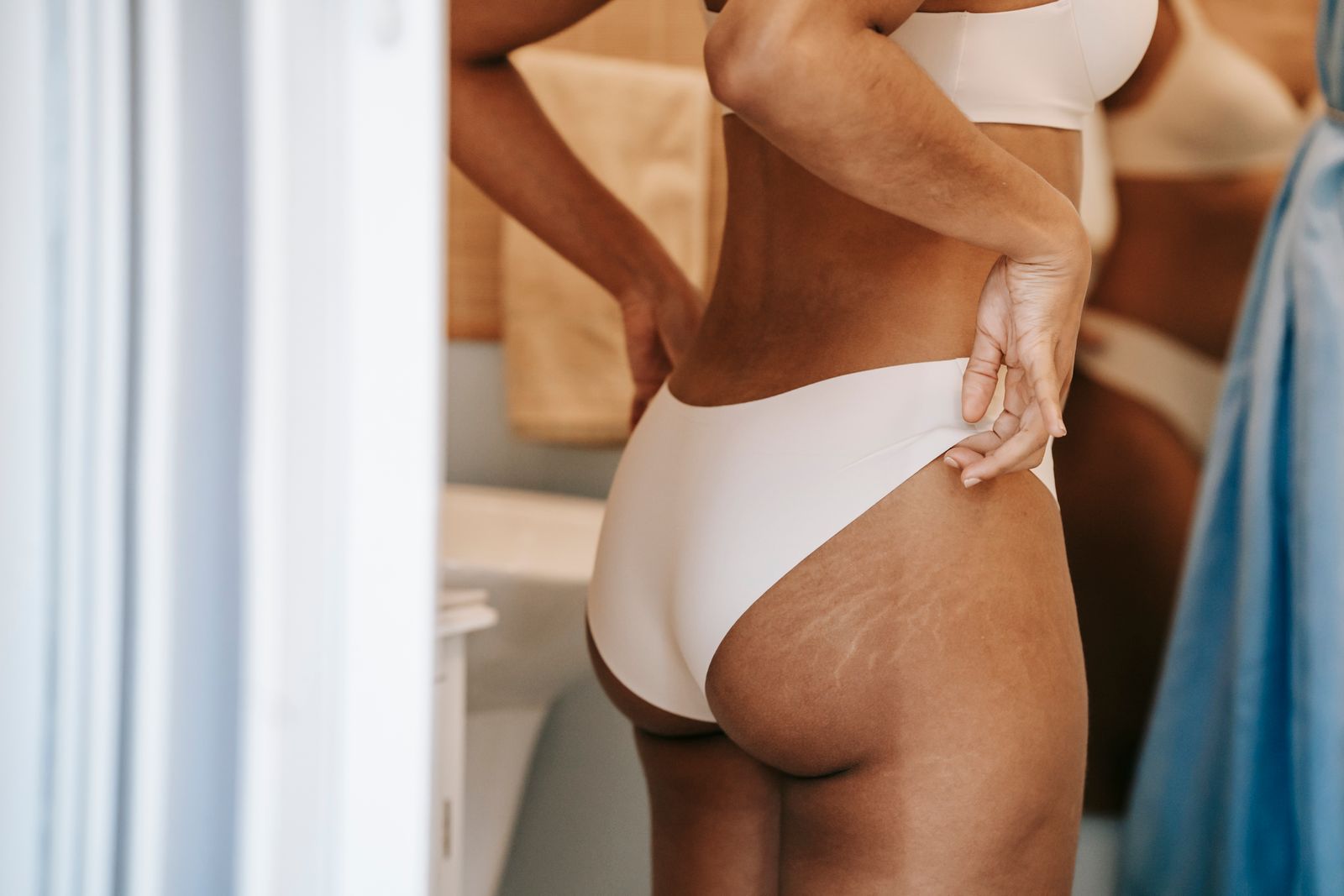
Yes. Color is the first thing to check, because new marks respond to more treatments than old ones. According to the American Academy of Dermatology, new stretch marks look red, purple, pink, reddish-brown or dark brown depending on your skin color. They can feel slightly raised and itchy.
Over time the color fades and the bands sink. An older mark often feels like a slight dent when you run a finger over it.
Stretch marks are a type of scar. They fade with time but do not disappear. Treatment can make them less noticeable sooner, so aim for "less visible," not "gone."
Creams do little for mature marks, and the drugstore favorites have failed in studies. Marks did not fade when people massaged in almond oil, cocoa butter, olive oil or vitamin E. Tanning makes marks stand out more because they do not tan. A self-tanner can hide both new and old marks while you work on fading them.
Does tretinoin work on stretch marks?
Yes, on new marks. In a six-month placebo-controlled study of tretinoin for early stretch marks, 8 of 10 people who applied 0.1% tretinoin cream daily to early, active marks had definite or marked improvement. Only 1 of 12 people using a plain cream improved that much.
The difference showed up early. By month two, the tretinoin group scored significantly better than the plain-cream group. By month six, their treated marks had shrunk 14% in length and 8% in width. The marks treated with plain cream grew 10% longer and 24% wider. The American Academy of Dermatology also names tretinoin as a prescription cream that may make early stretch marks less noticeable.
On its own, tretinoin does less than in-office procedures. A comparison of 14 randomized trials found that tretinoin alone ranked lowest of the options studied. Tretinoin paired with bipolar radiofrequency ranked highest. That makes tretinoin the place to start and the cream to keep using if you add a procedure.
Our clinical team can prescribe tretinoin if it fits your goal and your skin.
If you are pregnant or breastfeeding, check with your clinical team before you treat stretch marks. Some products, including ones that contain retinol, can harm a baby.
Which in-office stretch mark treatment works best?
Tretinoin plus bipolar radiofrequency had the highest chance of ranking best, both for results (84.5%) and for satisfaction (95.7%). Bipolar radiofrequency alone came close behind, at 75.3% and 84.3%. These percentages are the odds of ranking first among the options compared. They are not the share of women who improved, and the authors said larger trials are needed.
Adding platelet-rich plasma (PRP) to fractional CO2 laser also helped. PRP is a concentrate made from your own blood and injected into the marks. In a split-body study of 30 women, the side treated with laser plus PRP scored an average improvement of 60, compared with 44 for laser alone.
| Treatment | What the research shows | Typical sessions | Downtime | Cost |
|---|---|---|---|---|
| Tretinoin + bipolar radiofrequency | Highest odds of ranking best: 84.5% for results, 95.7% for satisfaction | Not listed | Not listed | Not listed |
| Bipolar radiofrequency alone | Second-highest odds: 75.3% for results, 84.3% for satisfaction | Not listed | Not listed | Not listed |
| RF microneedling | Not listed | Usually 3 to 4 | 3 to 5 days of redness and swelling | $800 to $2,500 per session, $2,400 to $10,000 for a course |
| Fractional CO2 laser | Darkening of treated skin was common in one study (see below) | 1 to 3 | 5 to 10 days of redness, swelling and shedding | $1,500 to $4,000 per session |
| Fractional CO2 laser + PRP | Average improvement of 60 vs 44 for laser alone in 30 women | Not listed | Not listed | CO2 cost plus $400 to $800 per session for PRP |
| Non-ablative fractional laser (such as Fraxel) | Not listed | 3 to 5 | Not listed | $800 to $1,500 per session, about $2,400 to $7,500 total |
The RF microneedling, fractional CO2 and PRP prices come from MedSpot's cost guide. The non-ablative fractional laser prices come from EatHealthy365. Insurance treats stretch mark procedures as cosmetic and almost never pays.
With CO2 laser, ask about darkening of the treated skin. In a split-body study of 24 people, 19 developed hyperpigmentation, which faded on its own by six months. The authors said it was especially common in Indian skin.
Which stretch mark treatment fits me?
- Your marks are new (red, pink or purple) and you are not pregnant or breastfeeding. Start prescription tretinoin nightly now, while the marks respond best. In the trial, the change showed up at about two months.
- Your marks are old (white or silvery, with a slight dent). A cream alone will do little. Budget for a series of radiofrequency or fractional laser sessions. Ask your clinical team whether tretinoin belongs in the plan alongside them.
- You want the best odds and can pay for procedures. The research favors combining treatments. Dermatologists may use more than one procedure, such as radiofrequency with a pulsed dye laser.
- Your marks came with weight loss or a pregnancy. These are two of the most common times stretch marks appear, and the skin can bother you even when you love the result. One woman wrote in r/30PlusSkinCare's "Crepey skin after weight loss" thread: "I lost over 60 lbs on a calorie deficit while lifting weights and I still struggle to like my skin."
If your stretch marks are still pink, red or purple, starting soon gives you the best chance of fading them. Take the quiz to see whether prescription tretinoin from our clinical team fits your plan.
Ready to make a move?
Answer three questions to see the treatment options that fit your goals.
See My PlanFAQ
How long does tretinoin take to fade stretch marks?
Tretinoin can start to make new stretch marks look better after about two months of daily use. In a six-month study of 0.1% tretinoin cream on early marks, the tretinoin group scored significantly better than the plain-cream group by month two, and by month six their marks had shrunk while plain-cream marks grew. Tretinoin works best on new red, pink or purple marks, so starting early gives you the best chance.
Do stretch marks go away on their own?
No, stretch marks do not go away completely on their own. They are a type of scar, so over time they fade from red or purple to white or silvery and sink slightly, but they stay. Treatment can make them less noticeable sooner, and new marks respond to more treatments than old ones.
Can I use tretinoin on stretch marks while breastfeeding?
Check with your clinical team before you use tretinoin or any other stretch mark treatment while breastfeeding. Some stretch mark products, including ones that contain retinol, can harm a baby. A self-tanner can hide new and old marks in the meantime.
Is laser stretch mark removal covered by insurance?
No, insurance almost never covers laser treatment for stretch marks, because it treats stretch mark procedures as cosmetic. MedSpot's cost guide lists fractional CO2 laser at $1,500 to $4,000 per session, and EatHealthy365 lists non-ablative fractional laser such as Fraxel at $800 to $1,500 per session, about $2,400 to $7,500 total. Laser makes stretch marks less noticeable rather than removing them completely.
Keep reading
Sources (5)
- Topical tretinoin (retinoic acid) improves early stretch marks · pubmed.ncbi.nlm.nih.gov · captured October 5, 2026
- Comparative effectiveness of different therapies for treating striae distensae · pmc.ncbi.nlm.nih.gov · captured October 5, 2026
- Efficacy of Fractional Carbon Dioxide Laser versus Fractional Carbon Dioxide Laser with Platelet-Rich Plasma in Treatment of Striae Distensae in a Tertiary Care Center: A Comparative Study · pmc.ncbi.nlm.nih.gov · captured October 5, 2026
- Combined Fractional CO 2 Laser With Intradermal Platelet-Rich Plasma versus Fractional CO 2 Laser Alone in the Treatment of Striae Distensae · pubmed.ncbi.nlm.nih.gov · captured October 5, 2026
- Stretch marks: Why they appear and how to get rid of them · aad.org · captured October 5, 2026